
The most beautiful abbeys of Burgundy

©javarman3/iStock
Romanesque vaults, sculpted tympanums and peaceful cloisters mark the landscapes of Burgundy-Franche-Comté, where a thousand years of monastic art have shaped the hills. From Cluny to Fontenay, Cîteaux and Vézelay, these remarkable sites chart the evolution of medieval architecture through a sequence of abbeys unlike any other in France.
Cluny, once the largest church in Europe
The approach to Cluny reveals a skyline of tiled roofs and the vast Gothic façade of the so-called Palace of Pope Gelasius, dating from the fourteenth century. Founded in 910, the abbey became the centre of a network of nearly 1,200 monasteries that spread across Europe. Only the southern transept remains today, yet its scale still conveys the magnitude of what was once the greatest church of the Middle Ages – larger even than St Peter’s in Rome.
Inside the Museum of Art and Archaeology, housed in the former abbatial palace, you can see original sculptures, models and artefacts unearthed during archaeological excavations. Around the site, the pattern of the old streets still traces the monumental footprint of the abbey.

©Pascale Gueret/Getty Images Plus
Paray-le-Monial, the purest expression of the Cluniac style
Less than an hour from Cluny, Paray-le-Monial rises from the gentle pastures of the Brionnais. Its twelfth-century Basilica of the Sacred Heart remains almost entirely intact – a masterpiece of Cluniac architecture expressed in a simpler, more restrained form. The symmetry of the nave and the way light plays across its Romanesque capitals create an immediate sense of harmony.
You walk slowly between the columns, taking in the carvings of leaves and biblical figures, before wandering along the village streets lined with walled gardens and quiet courtyards that reflect the basilica’s tranquillity.

Basilique du Sacré-cœur de Paray-le-Monial (Bourgogne-Franche-Comté, France)
Tournus, one of the oldest Romanesque churches in France
As you reach Tournus, the square towers of the Abbey Church of Saint-Philibert rise clearly above the rooftops. Begun in the tenth century, this remarkable building has a nave roofed with transverse barrel vaults supported by massive pillars.
Step through its doorway into a bright cloister, then continue into what was once the monastic precinct, now part of the medieval town centre. Down by the River Saône, the coloured façades shimmer in the still water.
At Le Quai, chef Valéry Meulien reinterprets the region’s classic dishes with finesse, served with a view of the river – an ideal pause before you continue your journey.

©Borisb17/iStock
Cîteaux, cradle of the Cistercian order
East of Dijon lies the Abbey of Cîteaux, birthplace of the Cistercian order. Founded in 1098 by Robert of Molesme, it called for a return to the simplicity of the Benedictine rule. The order spread swiftly throughout Europe, and Cîteaux remained its spiritual centre. Today, the monastery is still home to a community of monks.
Guided tours reveal the scriptorium, library and spaces devoted to contemporary monastic life. Before you leave, stop at the abbey shop, where the monks sell their own produce – aged cheeses, herbal infusions and fragrant gingerbread made on site.
Fontenay, preserved for nine centuries
Hidden in a wooded valley away from the main roads, the Abbey of Fontenay has stood serene for nearly 900 years. Founded in 1118 by Saint Bernard, it retains all its principal buildings, including the church, cloister, dormitory, chapter house, forge and canal. Walk beneath its graceful arcades, fingertips brushing the smooth stone, before entering the church, where the soft light enhances the purity of its lines.
One of the first French monuments to be inscribed as a UNESCO World Heritage Site, Fontenay exemplifies the Cistercian ideals of simplicity, harmony and order. A guided visit offers insight into the rhythm of monastic life and the function of each space.
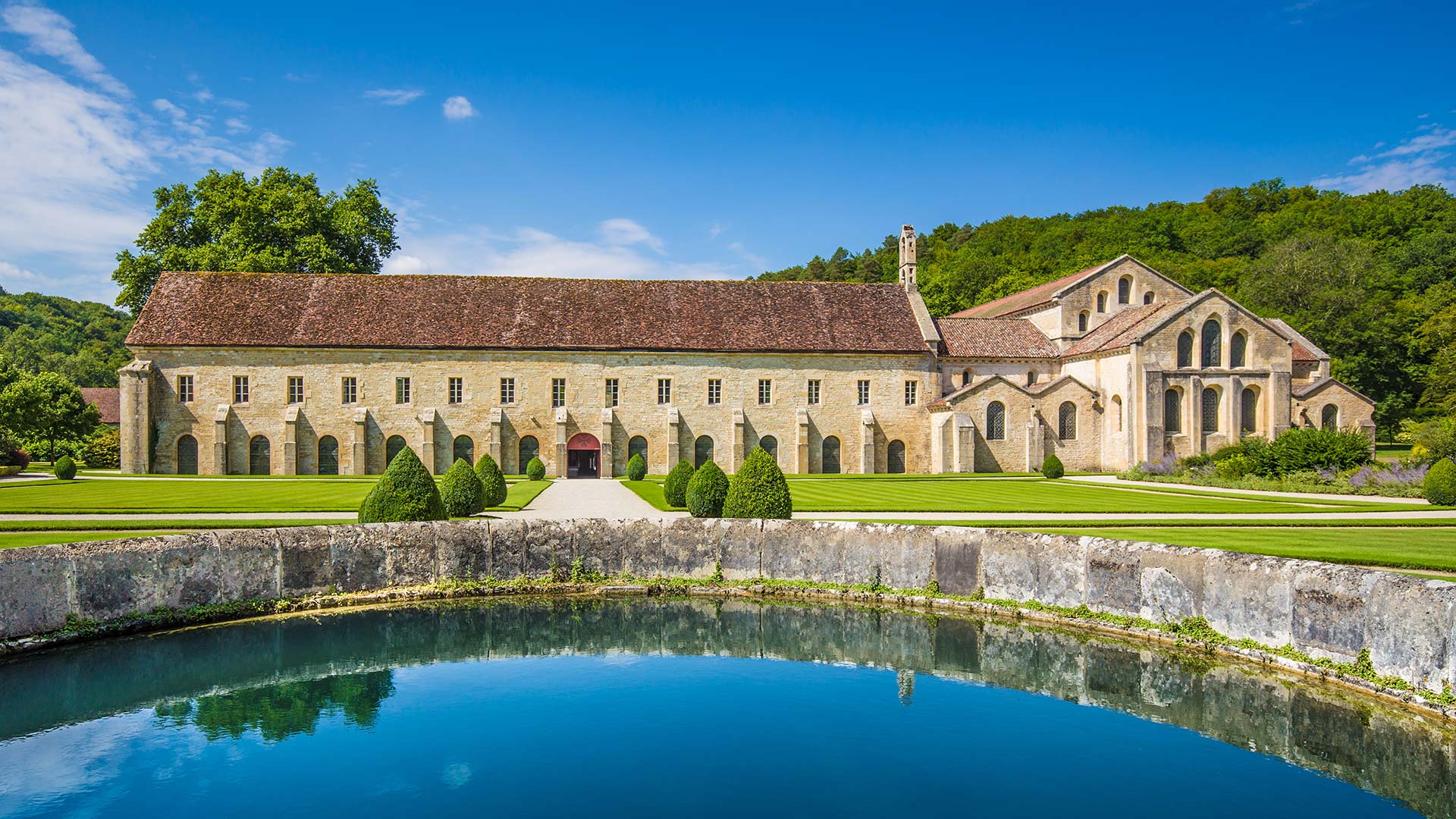
©bluejayphoto/iStock
Pontigny, an early Gothic landmark
A short drive from Auxerre brings you to the Abbey of Pontigny, whose vast nave stretches for 120 metres. Founded in 1114 as the second daughter house of Cîteaux, Pontigny ranks among Burgundy’s earliest examples of Gothic design.
The tall, pointed arches draw the gaze upward, while the whitewashed walls, free of elaborate stained glass, heighten the sense of austerity. As you move towards the choir, the clarity of sound and space creates a deep atmosphere of calm.
From May to September, concerts fill the abbey with sound – from Gregorian chant to chamber music – each performance enhanced by the building’s remarkable acoustics.
©javarman3/iStock
Vézelay, a hilltop basilica and a UNESCO treasure
Rising from a limestone spur above the wooded ridges of the Morvan, the Basilica of Sainte-Marie-Madeleine at Vézelay has drawn pilgrims since the eleventh century. It remains one of the key stopping-points on the Way of St James. Passing beneath the central portal, you come upon the tympanum of the Last Judgement, a masterpiece of Romanesque sculpture alive with intricate detail.
Inside, the play of light leads the eye towards the carved capitals depicting biblical scenes, allegories and fantastical creatures. After your visit, wander through the steep medieval lanes lined with old stone houses and craft workshops.
The Morvan Regional Natural Park, easily reached from Fontenay or Vézelay, offers waymarked trails through forests, lakes and meadows – a peaceful way to extend your journey, whether on foot or by bicycle.

Vue sur la basilique Sainte-Marie-Madeleine de Vézelay (Bourgogne-Franche-Comté, France)
La Charité-sur-Loire, the best-preserved daughter of Cluny
The journey ends at La Charité-sur-Loire, on the right bank of the Loire. Founded in the late 11th century, this priory was linked to Cluny and counted among its five eldest daughters. Inside the Church of Notre-Dame, the carved portal and vast nave recall the grandeur of its origins.
At its height, the church measured 122 metres in length and rose 27 metres beneath its domes. Around it stands one of the largest surviving Cluniac convents in Europe. As you wander through the historic quarter, follow the ramparts and the medieval bridge down to the riverbank of the Loire, where a quiet sense of monastic devotion still seems to hang in the air.

©louis bertrand/iStock


Feel like getting away from it all?
See our suggestions for novel trips and must-see places to visit near your home or holiday destination.