
Spain’s finest cathedrals

©Geng Li/iStock
Whether majestic or discreet, Gothic or modernist, Spanish cathedrals form an exceptionally diverse architectural collection. Discover them and dive into eight centuries of religious art, from Islamic splendor to Catalan daring.
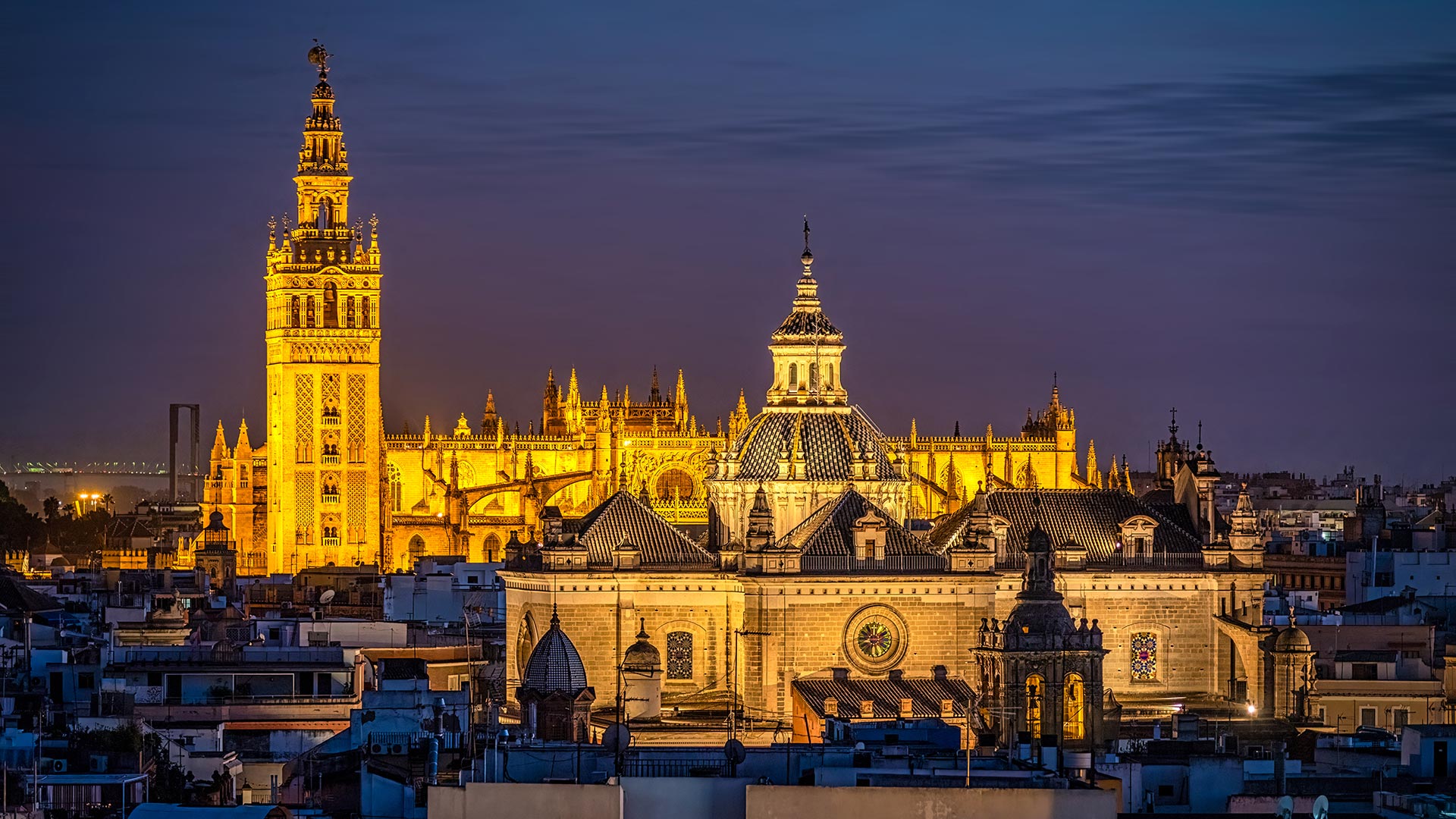
Seville Cathedral: Gothic grandeur in Andalusia
126 meters long and boasting an impressive central nave, Seville Cathedral is one of the largest in the world. You can explore it walking the length of several chapels, including the exceptional Capilla Mayor, up to the gigantic altarpiece in the choir, a masterpiece begun in 1482 and completed a century later. In the sacristy, you discover Christopher Colombus’ tomb along with a remarkably fine collection of gold and silverware.
The building stands on the foundations of the large Almohad mosque, of which the Orange Tree Courtyard and Giralda Tower survive. A ramp designed for riders takes you up the tower. At the top, the view encompasses Baroque domes, the patios of Santa Cruz, and the rooftops of Seville.
©Eloi_Omella/Getty Images Plus
Most religious buildings in Spain have an entrance fee. For the most popular sites, such as the Sagrada Família and Seville Cathedral, it is recommended to book your tickets well in advance.
The Sagrada Família in Barcelona: Catalan modernism under construction
Designed by Antoni Gaudí from 1883 onward, the Sagrada Família is the most famous building in Barcelona and perhaps the whole of Spain. At the heart of the Eixample district, discover an extraordinary architectural project: thousands of tree-inspired columns, a central nave bathed in light filtering through multicolored stained glass windows, and hundreds of slender vaults. Three facades adorn the exterior, including the still-unfinished Glory facade.
The Nativity facade, which is the most detailed, is teeming with sculpted figures depicting animals, plants, and saints. The more austere Passion facade portrays the crucifixion with a highly geometric rigor. In the crypt, you can admire Gaudí’s models and gain an understanding of the technical challenges of a project that is scheduled to be completed in 2026.

La Sagrada Família de Barcelone (Catalogen, Espagne)
Burgos Cathedral: a Castilian Gothic masterpiece
From Plaza del Rey San Fernando, look up to appreciate the 88 meter-high spires of the cathedral overlooking Burgos, in the province of Castile and León. Listed as a UNESCO World Heritage Site, this cathedral begun in 1221 illustrates the height of Castilian Gothic style. You enter through a portal decorated with Biblical statues, then come to the nave.
El Cid Campeador and Doña Jimena’s tomb rests under an understated slab in the center of the building. Nearby, the Condestable’s Chapel displays twisted columns, coats of arms, and flamboyant stained-glass windows. Linger in front of the choir stalls, sculpted in the 16th century, then lift your eyes to admire the rose windows that cast a colored light.
Follow the BU-800 west for two kilometers. You then reach the royal Monastery of Santa María la Real de Las Huelgas, founded in the 12th century. Less busy, it is home to royal sepulchers, a Cistercian cloister, and a remarkable series of medieval frescoes.

La cathédrale de Burgos (Castille-et-León, Espagne)
Santiago de Compostela: the cathedral at the end of the road
On reaching Plaza del Obradoiro in Santiago de Compostela, you discover a Baroque facade that fills the whole horizon: designed like a theater, it marks the end of the Camino and attracts a crowd of visitors. Its Portico of Glory, a Romanesque masterpiece by Master Mateo made up of over 200 carved figures, tells the story of the Apocalypse.
Inside the cathedral, the layout in the form of a Latin cross is organized around a wide ambulatory, allowing you to make your way to the choir. In the adjoining museum, you can admire Flemish tapestries, medieval sculptures, and models recounting the building’s construction from the 11th to the 18th century.

La cathédrale de Saint-Jacques-de-Compostelle (Galice, Espagne)
Mosque-Cathedral of Córdoba: a double heritage that is one of a kind
Few places offer this kind of architectural coexistence: constructed by the Umayyads from 785, the Mosque of Córdoba was converted into a church in the 13th century after the Reconquista. From the entrance, you walk through a forest of 850 marble columns, each topped with a red brick and white stone arch. You then reach the mihrab, a niche covered inmosaics that represents the epitome of Cordovan Caliphate art.
In the center, Renaissance cathedral, inserted in the 16th century, introduces Baroque chapels and cupolas. You move from an Islamic world into a Christian setting, before exiting to the Courtyard of the Orange Trees, dotted with pools and irrigated like an Andalusian garden. Delightful!

Vue sur la mosquée-cathédrale de Cordoue (Andalousie, Espagne)
Toledo Cathedral: the showcase of royal Castille
Begun in 1227, Toledo Cathedral reflects the power of Castille and the city’s cosmopolitan feel. Pass through its sacristy, decorated with canvases by El Greco, Titian, and Goya. In the treasury stands Enrique de Arfe’s Custodia, a monumental, gilded silver monstrance measuring 2.5 meters.
You continue via the cloister, decorated with frescoes, before reaching the Transparente, an oculus pierced in the vault in 1721 to let light enter. The juxtaposition of Gothic, Renaissance, and Mudéjar styles reflects Toledo’s multicultural history.
Take the Carretera de Circunvalación to the Mirador del Valle viewpoint. In ten minutes, you reach a promontory, from which you can take in the whole expanse of the old city. The cathedral stands out clearly, surrounded by a tangle of ramparts and ocher houses.

©Elena Zolotova/Getty Images Plus
León Cathedral: the triumph of Spanish stained glass
Built in the 13th century, León Cathedral in the north-west of the country impresses less by its size than its lightness. You can admire the nave illuminated by some 1,700 square meters of medieval stained glass, including a spectacular central rose window flanked by two Gothic towers. This abundance, which is rare in Spain, is reminiscent of great French basilicas.
In the stained glass room, an exhibition guides you through the techniques for assembling and restoring the panes. The adjoining museum conserves illuminated manuscripts, Flemish paintings, and Romanesque sculptures in a more intimate setting.

©S. Greg Panosian/iStock
Salamanca Cathedral: two buildings combined
In Salamanca, you pass from the old Romanesque cathedral to the new one almost without moving. Begun in the 12th century, the first conserves a painted cupola and a squat tower, nicknamed “Rooster Tower.” To enter the new cathedral dating from 1513, you need simply go through an arch.
High Gothic vaults soar above Renaissance altarpieces. Step outside to examine the meticulously sculpted facade. Added in 1992, one detail catches your eye: an astronaut, which has become an emblem of the city and an unusual nod to the continuity between past and present.
©Geng Li/iStock


Feel like getting away from it all?
See our suggestions for novel trips and must-see places to visit near your home or holiday destination.