Morning: An architectural walk from the cathedral to the Boulingrin market
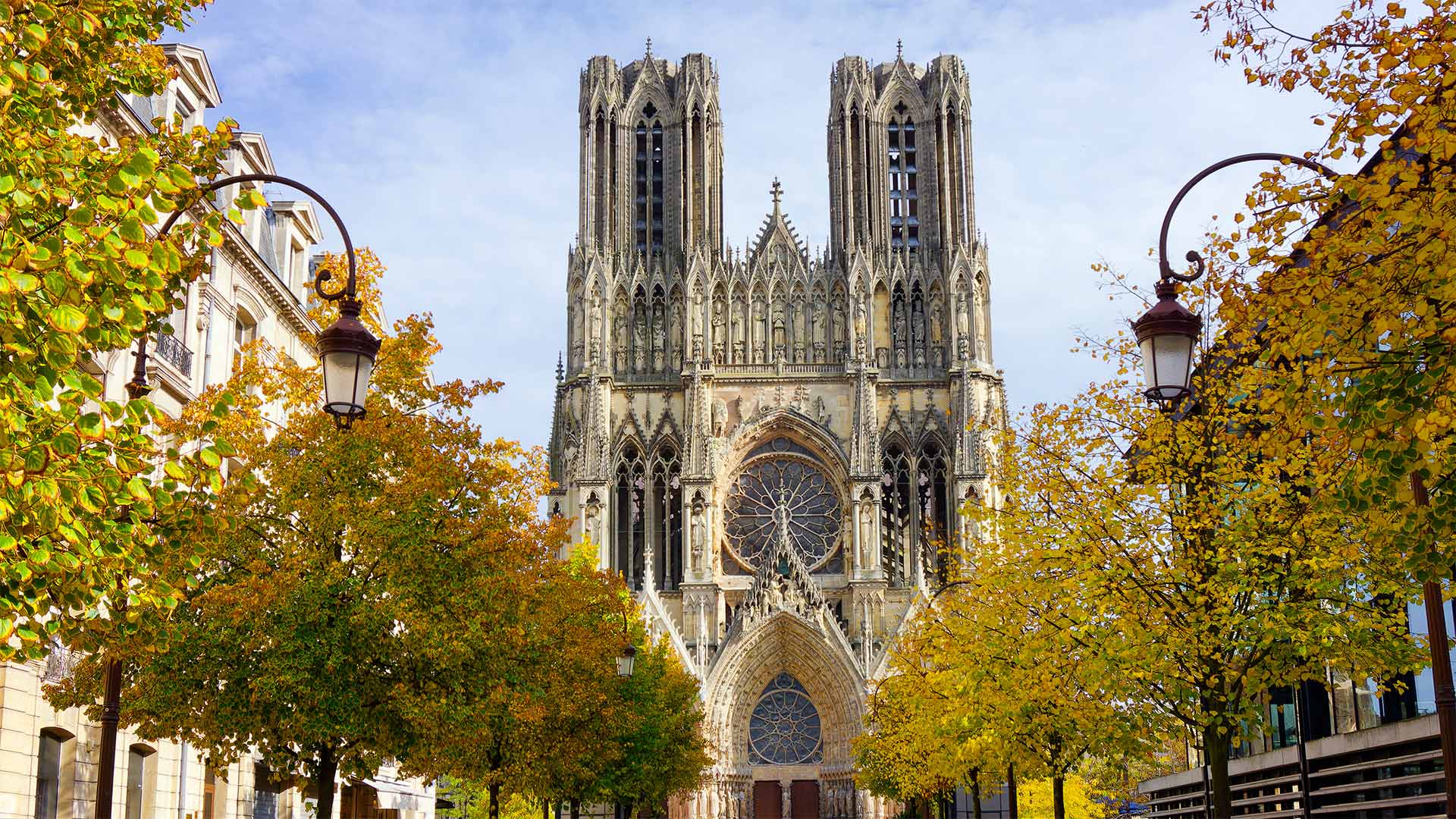
Your day in Reims starts in front of Notre-Dame Cathedral, the great landmark of the city. Begun in the 13th century, it hosted the coronation of 29 French kings. On the west front, you pick out the Smiling Angel among 2,303 statues. Inside, you walk up the nave to the axial chapel, where the windows Marc Chagall created in 1974 flood the space with deep blues and intense reds.
Back outside, a walk of about 40 minutes takes you through a downtown largely rebuilt after World War I. Your first stop is the Carnegie Library, opened in 1928 thanks to the patronage of American magnate Andrew Carnegie. Its mosaic entrance, an award winner at the 1925 Exposition of Decorative Arts, leads to a hall crowned by a dome lit through a magnificent glass lantern. At 11 rue des Élus, the Hôtel de la Mutualité shows another face of 1920s Reims, with carefully preserved wrought iron and Art Deco reliefs. You continue to cours Langlet and push open the door of Fossier, famous for its biscuits roses, the crisp pink cookies made for dipping in champagne.
A little farther on, the Musée-Hôtel Le Vergeur occupies a mansion built between the 13th and 17th centuries. Inside, you study some 50 engravings by Albrecht Dürer, including plates from The Great Passion (1511), hung in rooms paneled in dark wood. Heading up rue de Mars, you pass City Hall, whose 17th-century façade withstood the shelling and then the fire of 1917, before reaching the Boulingrin market halls.
One of the essential sights in town, the Palais du Tau, the archbishops’ residence listed as a UNESCO World Heritage Site, has been closed for renovation since 2023. Reopening as the Museum of the Coronations is planned for 2027.

©tichr/iStock
Midday: Lunch across from the covered market
Here you are in front of the Boulingrin halls, the food-loving heart of Reims since 1929. The building runs 360 feet long and stands out for its vast parabolic concrete vault, a technical feat in its day. In the morning, growers and artisans sell vegetables, cheeses and charcuterie in a cheerful din. You have lunch across the street at L’ExtrA, in a 1920s building with Art Deco touches. The team, made up of people with intellectual disabilities working alongside two experienced professionals, serves a carefully sourced local menu of fresh morels, hake fillet and wild garlic panna cotta.
Before leaving the neighborhood, you make a detour to the Foujita Chapel, decorated by Tsugouharu Foujita. The Japanese painter of the School of Paris blends early Christian references, a distinctly Japanese line and Western iconography. On the right-hand wall, in the crowd drawn at the foot of the Cross, you spot the artist himself, slipped in among the figures.
Afternoon: From the Villa Demoiselle to the Basilica of Saint-Remi
After lunch, you head to the south side of Reims for the Villa Demoiselle (1904), a manifesto of local Art Nouveau patiently restored in the 2000s by the owners of the Vranken-Pommery champagne houses. Behind the flower-covered façade designed by Louis Sorel, you admire the dining room by Émile Gallé, recognizable by its artichoke-shaped table legs, a counter cabinet by Louis Majorelle and a spectacular fireplace carved with umbel blossoms by Paul-Alexandre Dumas.
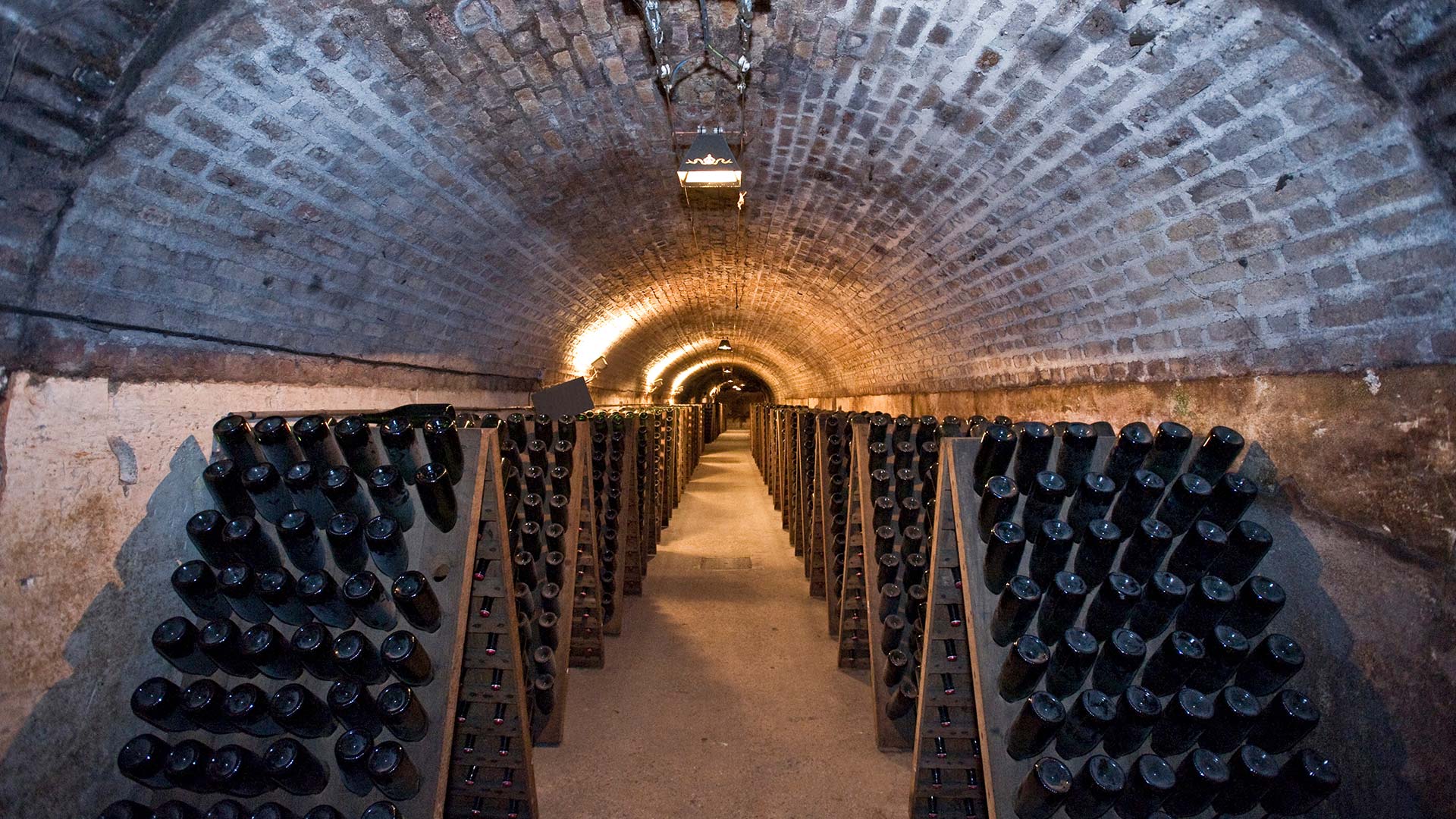
Just across the way, you continue into the Vranken-Pommery cellars, dropping 100 feet underground into 120 Gallo-Roman chalk pits linked by 11 miles of galleries. In the entrance hall, you notice the 20,000-gallon cask carved by Émile Gallé. Then you move through a setting where the air turns noticeably cooler, between 19th-century reliefs and contemporary art installations renewed every year. The visit ends with a champagne tasting. Allow at least two hours to enjoy both sites fully.
Later in the day, head for the Basilica of Saint-Remi, a vast Romanesque and Gothic church from the 11th century listed by UNESCO and known above all for its immense nave, 400 feet from end to end. You take in the tomb of Saint Remigius, the bishop who baptized Clovis, then spend time on the four-story Gothic chancel, where light filtered through the windows traces the lines of the columns. In the former abbey next door, now a museum, you extend the visit with Gallo-Roman mosaics, 16th-century tapestries and a collection of medieval sculpture from the Champagne region.

©MasterLu/iStock
Evening: Dinner at Domaine Les Crayères, on the Saint-Nicaise hill
To close the day, you reach the Domaine Les Crayères, a château built in 1904 by Madame Pommery for her daughter, the Marquise de Polignac. The place still feels like a grand country retreat, with refined rooms, old portraits, high ceilings and 17 acres of parkland.
Dinner is served at Le Parc, a two-star restaurant in the MICHELIN Guide, where chef Christophe Moret cooks close to the land, backed by a cellar of roughly 900 champagne labels. For a more relaxed evening, you can opt for the Brasserie Le Jardin, awarded a Bib Gourmand for good value, set in a pavilion in the middle of the grounds.
One more day in Reims?
If you have an extra day to spare, Épernay sits about 30 minutes away by car. You walk the avenue de Champagne, lined with private mansions and the historic headquarters of Champagne houses such as Moët & Chandon, Perrier-Jouët and Pol Roger. At number 20, you explore the Moët & Chandon cellars, 17 miles of galleries where 90 million bottles rests between 50 and 59 °F. The tour walks you through every stage of champagne making, for a sparkling finish.
©RandyRomano/iStock